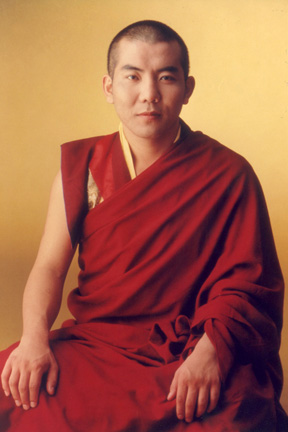
The Third Jamgon Kontrul, Karma Lodro Chokyi Senge
Karma Lodro Chokyi Senge -- the name of the third Kongtrul incarnation – will always be invocated with great reverence. He was an exemplar of unequalled kindness, whose aspirations and accomplishments for the Dharma and the Kagyu lineage shone, and continues to shine, a wondrous light on our dark times.
As his last testament, the previous Jamgon Kongtrul, Khyentse Ozer, stated that his reincarnation would be in central Tibet and that the household, parents, and time would be predicted by the Gyalwang Karmapa. Accordingly, in a first letter of recognition, the XVIth Gyalwang Karmapa wrote the following prophesy:
In the central part of the country, surrounded by snow mountains,
With the father's name De and the mother's Pema,
From a wealthy family of pure ancestry,
A boy of the wood horse year with excellent signs
Is without any doubt Jamgon, the incarnation of Lotsawa Vairocana.
Raising the victory banner of the teachings,
He will give life to all Buddhist traditions
And especially to the lineage of Gampopa.The 16th Eyalwang Kamape
In accordance with this vajra prophesy, Jamgon Kongtrul Rinpoche was born on the first of October, 1954, the male horse year of the sixteenth cycle, in Lhasa, from where the Dalai Lama guided the spiritual and temporal life of Tibet. His father was Tsering Tobgyal of Sadutshang, a prominent family, and his mother was Pema Yudron, the daughter of Sawang Ngawang Jigme Ngabo, a cabinet minister in the Tibetan government. Before and after his birth, numerous signs appeared to his mother, and he was recognized without any doubt as the reincarnation of Jamgon Kongtrul by His Holiness the Dalai Lama and the Gyalwang Karmapa.
Under their direction, Yonten Phuntsok, the Treasurer of the former Jamgon Kongtrul Rinpoche, repeatedly requested the Sadutshang family to entrust the tulku to his labrang. At last they consented, and when he was seventeen months old, Jamgon Kongtrul Rinpoche was formally recognized and offered robes and his title. At the age of six, he was enthroned by His Holiness the Gyalwang Karmapa at the old monastery in Rumtek, Sikkim. From then on, Jamgon Kongtrul Rinpoche as a heart son was inseparable from His Holiness, who supervised his education from the outset. At the age of thirteen, on the fifteenth day of Saga Dawa (the fourth Tibetan month) of the male fire horse year, he received from His Holiness the XVIth Karmapa, getsul ordination, along with Shamar Rinpoche and Tai Situ Rinpoche. He received the name, Jamgon Kongtrul, Karma Lodro Chokyi Senge, Tenpay Gocha Ngedon Gyurme Trinle Kunkhyab Palzangpo.
Jamgon Kongtrul Rinpoche then studied with Khenchen Thrangu Rinpoche, a great scholar and holder of the Vinaya. These studies included all the tantras of the Marpa tradition, especially those of the Karma Kamtsang, and the lama dances, preparation of mandalas, chanting and musical instruments pertaining to the practices of Padmasambhava, Vajrakilaya, and others. Jamgon Kongtrul Rinpoche received from Khyabje Kalu Rinpoche, master siddha and the activity emanation of Jamgon Kongtrul Lodro Thaye, teachings ranging from the Mahamudra Preliminary Practices of the Kamtsang tradition up to empowerments, reading transmissions, and explanations for Gyalwa Gyamtso, Demchok, Dorje Pagmo, and, especially, the Six Yogas of Naropa, Mahamudra, The Five Golden Teachings of the Shangpa Kagyu, the great empowerments of Kalachakra and Rinchen Terdzö, and at different times, countless other teachings of the new and old traditions.
At the age of twenty, on the fifteenth day of the first month (the month of miracles) in the female water ox year, he received full gelong ordination from His Holiness the XVIth Gyalwang Karmapa. Jamgon Kongtrul Rinpoche took gelong vows along with Chamgon Situ Rinpoche and Khyabje Gyaltsab Rinpoche, and was assisted by a master of procedure and other monks to complete the necessary number. Believing them to be the very foundation of the Dharma, Jamgon Kongtrul Rinpoche guarded carefully these precious Vinaya rules. He gave the ordinations of getsul and gelong to some three thousand monks in India, Nepal, and Tibet, and so became a great holder of the Vinaya.
From His Holiness the Gyalwang Karmapa, Jamgon Kongtrul Rinpoche received the bodhisattva vows from the traditions of Nagarjuna and Asanga.
Jamgon Kongtrul Rinpoche had great faith, respect, and devotion for his spiritual teachers. His relationship to the Gyalwang Karmapa, embodiment of all refuges, was a special one of total devotion, respect, and pure vision. Rinpoche served His Holiness perfectly and received from him all the profound oral instructions, including the Five Great Treasuries and explanations of the Kamtsang Kagyu. The realization of Mahamudra, which is the heart blessing of the ultimate lineage, was transferred to him and helped him become a great siddha.
In 1976 and 1980, Jamgon Kongtrul Rinpoche accompanied the Gyalwang Karmapa on tours of America, Europe, and Southeast Asia. After His Holiness' parinirvana, Jamgon Rinpoche continued to travel to Europe and Asia, establishing branches of the Rigpe Dorje Foundation in many countries and the Paramita Charitable Trust in India. Through empowerments, explanations, and advice, he generously gave teachings for three different types of students in accordance with their needs.
In 1983, in order to counteract obstacles to the swift return of His Holiness the Karmapa, Jamgon Rinpoche built a Sidok Stupa with the proper measurements, mantras, dharanis, and consecration. For the same reason, he initiated the practice of 100 million recitations of the Vajrasattva mantra every year on the occasion of Saga Dawa (the fourth Tibetan month). In 1984, following the wishes of His Holiness, he started the construction of a new building for the Karma Shri Nalanda Institute, which was inaugurated in June 1987. Jamgon Kongtrul Rinpoche not only provided all the furnishings of the entire building -- he also found the means to support the student body of some 150 tulkus, lamas and monks.
Jamgon Rinpoche visited Tibet in 1984, and at Palpung Monastery, he gave empowerments and teachings to a vast gathering of monks and laypersons, ordaining about 500 monks. He then visited Lhasa and the Tsurphu Monastery (the seat of His Holiness the Gyalwang Karmapa) where he gave further empowerments and teachings, and the ordinations of getsul and gelong to about one hundred monks. He also obtained permission for the reconstruction of Tsurphu, towards which he donated all the offerings that were made to him during his journey.
In 1988, Rinpoche constructed a new monastery at Lava near Kalimpong, West Bengal, where today about 125 monks reside, of whom ten are involved in a three-year retreat in the tradition of the golden Dharma in the Shangpa Kagyu. In 1988 he also started the construction of the Pullahari Retreat Center in Nepal, where there are now about fifteen monks practicing. In 1990, he gave the great Kalachakra empowerment to the monks and laypersons of Rumtek and donated funds to initiate the conducting of the Kalachakra puja there on an annual basis.
In 1991, Jamgon Kongtrul Rinpoche returned to Tibet and visited Derge Gonchen where he gave an empowerment, re-consecrated the old and new Derge Printing House, and made donations to them. He then journeyed on to Palpung Monastery and gave the great Kalachakra initiation to about 550 tulkus and lamas of the area, including Sangye Tendzin of Japa Gonzhab Surmang Tentrul, Dodrak Tulku, before a crowd of about 10,000 laypersons. He also gave getsul and gelong ordinations to about 550 people. Next he travelled to Damkar Monastery in Nangchen where he again gave the Kalachakra empowerment to about 10,000 sangha members, including lamas and tulkus such as Shangu Tulku, Kyodrak Tendzin, Salga, Drukpa Tulku, and Demon Tulku.
In February 1992, he gave the Kagyu Ngakdzö empowerments to the monks, nuns, and lay people of Rumtek, and to numerous sangha members from the East and West. He also inaugurated the new building of Karma Jamyang Khang, a primary school for monks, for which he had arranged funding and participated in the design and construction. As his last activity, Jamgon Kongtrul Rinpoche offered mantras and dharanis to fill the new statue of the Buddha in the main shrine hall of Rumtek monastery. Due to his pure samaya with His Holiness, he was able to cover the entire statue with gold. After consecrating the statue, Jamgon Rinpoche told his attendants, "Now I have fulfilled the wishes of His Holiness."
In describing Jamgon Rinpoche one can quote:
Prayer to the source of all qualities, the one rich in faith, discipline,
learning, generosity, intelligence, modesty, and humility
I pray to you, source of all qualities, the one rich in faith, discipline,
learning, generosity, intelligence, modesty, and humility.
From childhood, he naturally displayed all the qualities of a noble being. His faith in the pure vision of his teachers was unparalleled, and his devotion to his root lama, Vajradhara Gyalwang Karmapa, was fully equal to that of all the previous lineage holders of the Kagyu tradition. From the time His Holiness became ill, until he dissolved his mind into the dharmadhatu, Jamgon Kongtrul Rinpoche was not separate from him for even one moment. He was tireless in attending to the physical needs and following the commands and wishes of his lama.
Jamgon Rinpoche studied numerous sutras, tantras, their commentaries and oral instructions. As a sign of having genuinely realized these teachings, he displayed the qualities of faith, pure vision, loving-kindness, and genuine concern for the well-being of others that were so much a part of him that they became inseparable from his name. He constantly fulfilled the wishes of others through giving away all that was offered him to build monasteries, establish centers of learning and practice, to create representations of the Buddha's body, speech, and mind, and to support the sangha and the poor and needy.
With clear wisdom of the world and of Dharma, he soothed the mental sufferings of others, cut through the net of their doubts, and guided them onto the right path through direct and indirect means. To his attendants and all those, high or low, with whom he interacted, Jamgon Rinpoche always displayed the qualities of constant friendship, modesty, humility, and gratitude.
At the age of thirty-nine (by the Tibetan calender), Jamgon Kongtrul Rinpoche suddenly passed away. Considering his age, learning, qualities, aspirations, and activities, his passing was an unbearably sorrowful event for his disciples and all who knew him. Yet, as ordinary people with limited understanding and realization of how things truly are, we should always look at his life with pure vision, great faith, and devotion.